
Grounding: Returning Home to the Body of the Earth
Grounding is not mystical or distant. It is available in every moment you choose to pause and feel
Most mornings I walk outside into soft sunlight, barefoot. I feel the cool dew beneath my toes and the tickle of grass. I let my weight settle through my heels, arches soft, toes open. With one deep breath, presence returns quietly through the body. The cats chase a butterfly, the dog rolls in the grass and the day begins a little differently.
We live so much of our lives in our heads that we forget the simple medicine of being held by the ground. Grounding is that return. It is the art of coming home to your body and to the body of the Earth. It is remembering that we were never separate, only distracted.
When we ground, we remind the nervous system that we belong here, not only in mind or spirit but in this miraculous breathing body. Grounding does not ask you to become someone new; it invites you to remember who you already are.
The Mindful Connection
“Each step, each breath, becomes a prayer of presence.”
Mindfulness gives grounding its inner depth. When we walk or sit mindfully the body becomes a temple of awareness. Thich Nhat Hanh called this “coming home to the present moment”.
In mindfulness, attention is affection, a gentle noticing that reconnects us to what is real. The more we practise it, the more we sense that the ground itself is alive and that we are part of its living rhythm.
The Spirit of Grounding
Across the world’s traditions grounding has always been sacred. In yoga it is prithvi tattva, the element of earth. Mountain Pose (Tadasana) teaches this beautifully: feet firm and awake, kneecaps lifted, pelvis neutral, heart open, crown lengthening to the sky. You root to rise.
In the subtle body the root chakra (Muladhara) anchors safety, trust and belonging at the base of the spine. When balanced it steadies our energy and restores a felt sense of home.
In Buddhism grounding is symbolised by the moment of the Buddha’s awakening, when he touched the Earth with his right hand and called it to witness his truth. The Earth responded, bearing witness to his right to awaken.
In Indigenous cosmologies the Earth is not a backdrop but a being, Pachamama, the living mother who sustains all.
To be grounded is to pause long enough to feel the current moving through you, the same current that stirs oceans, roots and wind. When we slow down to listen we realise the Earth is not beneath us, it is within us.
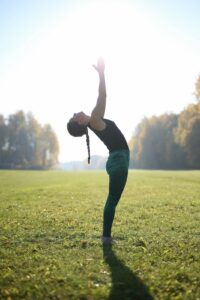
The ancients knew this. They prayed barefoot, planted seeds by hand, walked slowly, listened deeply. They understood that connection to the Earth was connection to Spirit. In grounding we honour that sacred relationship between inner stillness and outer soil and we remember our place in the circle of life.
The Science Beneath the Sacred
Modern research is beginning to map what ancient intuition has long known: our relationship with the Earth is not only spiritual, it is energetic.
The term earthing refers to the physical act of direct contact between the skin and the surface of the Earth. The Earth’s surface carries a subtle negative charge and when our bodies touch it, our electrical potential equalises with that of the planet.
Studies suggest that earthing can influence physiology in measurable ways. Grounded subjects show reduced inflammation, thinner blood and improved heart rate variability, all signs of a balanced nervous system.
In one study, two hours of earthing increased the natural negative charge on red blood cells by 270 percent, helping them repel one another and flow more freely. This lowered blood viscosity and may support cardiovascular health.
In sleep studies participants using grounded mats reported better sleep and lower night-time cortisol. Athletes who earthed after intense exercise recovered more quickly with less soreness and inflammation.
Although the flow of electrons is tiny, researchers propose that the body’s connective tissues form a living matrix that can conduct this subtle charge through the body, supporting immune balance and repair. The field is still young, yet these findings offer a fascinating bridge between physics and physiology.
The Physiology of Feet: Nature’s Healing Circuit
Our feet are designed to commune with the Earth. Each one holds more than 7,000 nerve endings, a network constantly relaying information about balance, texture, temperature and safety. These nerve endings end where the Earth begins; they are portals of perception and healing.
In reflexology and acupuncture the feet are maps of the body. Stimulating specific points on the soles can influence organs and meridian pathways, restoring balance to the whole system. When we walk barefoot, especially on natural surfaces, we awaken these pathways and renew an ancient dialogue between body and planet. The result is not only physical grounding but emotional steadiness, a literal rooting of the nervous system.
The Emotion of Grounding
When we are ungrounded we spin. Thoughts race, breath shortens, safety feels out of reach. Grounding anchors the mind through the body.
Therapists and trauma specialists often use grounding techniques to regulate the nervous system: feeling the soles of the feet, noticing the weight of the body, sensing the earth below. These simple acts tell the body you are safe now. They bring us back from anxiety or overwhelm into the present moment where healing can begin.
Emotionally, grounding is a return to trust, to the felt sense of being supported. It allows us to hold discomfort without becoming it and to meet change without losing our centre.
The Philosophy of Grounding
To be grounded is to belong.
In a world addicted to speed and distraction being grounded is a quiet rebellion. It is saying no to the noise and yes to the wisdom of roots. A tree’s roots are its strength, drawn from the depth of stillness.
When we ground ourselves we align with that steadiness. We stop living from the outside in shaped by reaction and hurry and start living from the inside out guided by presence and integrity.
Grounding is also about trust, trusting that what is unseen is still working on our behalf. It is remembering that growth thrives in silence, that worth is not measured by pace and that the Earth beneath us holds more intelligence than we can imagine.
The Practice of Grounding
Begin with your feet. Step outside in morning light. Feel the surface beneath your toes. Let your weight settle. Breathe slowly three times.
Other simple rituals:
- Place your hands on the bark of a tree and feel its texture and pulse
- Sit on the ground with a cup of tea and let the Earth support your spine
- Breathe deeply and visualise roots descending from your feet into the soil
Each act, however small, is a homecoming.
The Science and the Skepticism
The scientific evidence for earthing is promising yet still limited. Many studies are small, controls can be weak and outcomes are sometimes subjective. Critics suggest the benefits may come less from electron transfer and more from what is already well established: time in nature, relaxation and mindful attention.
Physicists note that the flow of electrons is incredibly small and question whether it can meaningfully affect biology. Others caution against oversimplifying oxidative stress as something electrons alone can neutralise. Even so, there is broad agreement on this: being in nature lowers stress, improves mood and fosters balance, whether or not we call it grounding.
So while the science continues to unfold, the invitation remains simple. Walk barefoot, breathe deeply, reconnect with what is real.
Because whether it is electrons, stillness or sunlight, the Earth’s medicine begins the moment we stop rushing and start feeling.
The Remembering
Grounding is not about escaping the world. It is about arriving fully within it. The more rooted we are, the more open our hearts become. The steadier our presence, the deeper our compassion.
When we ground we remember that we are not separate from nature’s intelligence, we are made of it.
So the next time you feel unsteady, go outside. Take off your shoes. Let the Earth meet you where you are. Feel its quiet pulse answering yours.
Because the ground beneath you is alive, and it has been waiting for you to take root.