The Year of the Horse
Moving From Stillness Into Power
Picture a field in early morning light. The grass is heavy with dew. A lone horse stands in the pale hush before the day begins, its breath rising like a small cloud into the cool air. It shifts its weight as if listening to something only it can hear. Then, without warning, its muscles gather and it breaks into a steady, purposeful gallop.
That shift from stillness into motion is the threshold we are crossing now.
From the Year of the Snake to the Year of the Horse
For the last year we have lived in the energy of the Snake. In Chinese astrology the Snake is an inward season, a time of healing and shedding. Many felt it as a pull towards honesty, emotional reflection and quiet transformation. But a new rhythm is rising. The Year of the Horse arrives with movement, vitality and the kind of clarity that comes from having travelled inward first.
The Horse symbolises momentum rooted in intuition. Not frantic rushing, but the grounded confidence that comes from knowing the earth beneath your feet. Horse energy widens possibility. It urges us to move forward with courage and to trust the inner direction that has been forming quietly beneath the surface.
Where the Snake invited letting go of what no longer serves you, solitude and reflection, the Horse invites expression, connection and bold steps taken with a clear heart.
“In riding a horse, we borrow freedom.” — Helen Thompson
The Herd: Moving Together
A core part of this energy is the herd. Horses draw confidence from one another. They read subtle cues in breath and posture and they move with a deep sense of belonging. In the same way, Horse years remind us that we rise more steadily when we feel supported and accompanied.
People born in Horse years tend to be sociable and intuitive in this way. Yet, like all powerful energies, this year carries its own challenges. When it flows well it becomes creativity and decisive action. When unbalanced it can turn into restlessness or moving too quickly without anchoring first.
On a collective level Horse years often coincide with periods of rapid change. Innovations arrive faster, systems shift and the world feels as if it is gathering speed.
It is a fertile time for bold ideas and new ventures, and a particularly supportive year for entrepreneurs who feel ready to take a chance on something they believe in.
It is also a gentle reminder not to outrun ourselves. Burnout arrives quickly in high energy years so grounding becomes as important as momentum.
In relationships the Horse brings warmth and expressive connection. There is a longing for shared adventure, for romance that feels alive and wholehearted. Sparks can feel more passionate. The invitation is to meet others with presence while staying centred in your own rhythm.

This instinctive, spirited quality of the Horse appears across cultures. Many traditional societies have long recognised in the horse a blend of strength, alertness and a kind of embodied wisdom.
Mongolia: Freedom and the Living Bond
Across the vast grasslands of Mongolia, horses live in a state of freedom that has shaped the Mongolian heart for centuries. Their relationship with humans is often described as one of respect and partnership rather than domination.
Horses roam open grasslands in their herds, choosing their own paths and grazing with the rhythms of the land. A horse raised in this way tends to remain alert, strong and responsive to its environment. Many herders speak of developing an intuitive bond with their animals, reading subtle shifts in movement and breath as though they are reading the land itself.
Training is traditionally patient and calm. While some degree of breaking in is part of working with semi-wild horses, many Mongolians emphasise an invitation over force and speak of guiding rather than overpowering.
In some lineages, spiritual care is woven into daily life. People brush the mane while speaking blessings, or offer milk before a long journey. Some traditions involve singing long songs believed to steady a horse’s heart. In certain shamanic and Tengrism practices, horses are understood to carry a connection between sky, earth and the unseen realms.
In Mongolia it is said that a horse becomes a person’s wings. Neighbouring cultures say that horses lend us the wings we do not have. Both proverbs arise from people who learned life through open land and animal companionship, and both remind us that a horse offers something beyond transport. It offers a way of feeling the world widen beneath you.
Native American Traditions: Relatives and Sacred Partners
A similar reverence appears across many Native American nations. When horses were reintroduced to the continent in the 1500s, several tribes described the moment as a kind of return rather than a beginning.
Horses were welcomed in some communities as relatives, part of the Horse Nation, beings with their own wisdom. Among the Lakota and the Diné, for example, horses appear in stories and ceremonies as protectors and guides. Some traditions say that to mistreat a horse is to disturb the balance of the natural world.
Dreams of horses are taken seriously in many communities. A dream horse may be seen as a messenger, offering courage or signalling a need for harmony to be restored.
Elders often speak of the wellbeing of the horses mirroring the wellbeing of the people.
Today, many Indigenous horse programmes frame their work not as a modern innovation but as a return to ancestral ways of relating and rewilding.
Awe, Wildness and the Psychology of Presence
“The soul is a horse longing for the open.” — Sufi metaphor
For those who encounter wild horses, there is often a sense of awe. The writer Chad Hanson describes this in The Wild Horse Effect, reflecting on how standing near a wild horse can open a wider, more spacious way of sensing the world.
Many people report that such moments soften the ego and quieten the mind. Research on the psychology of awe suggests that awe can calm the nervous system and foster connection, though specific studies on wild horses themselves are limited.
Psychologists studying awe describe similar patterns. Although research on wild horses specifically is limited, many studies suggest that awe can settle the nervous system and create a sense of connection. People often experience a gentle shift in physiology: the breath slows, tension eases, and the mind becomes quieter. Some researchers suggest that awe may lower cortisol and increase the neurochemistry associated with trust and calm, though these findings are still developing. For those who have felt it, the effect is unmistakable, standing near a powerful, attuned animal can open a deeper presence. The sense of self grows softer, not diminished but expanded, as if the borders of the body loosen and the world becomes more spacious.
Still, many who spend time with them describe a feeling of groundedness and a deepening of presence.
The Divine Feminine and the Instinctive Self
This is also where the horse begins to reflect the divine feminine. If you place the wild woman archetype beside the horse you see an unmistakable resonance. Both live from instinct. Both resist confinement of spirit. Both protect their herd.
Both carry an embodied intelligence that listens to the cycles of nature rather than outer expectation.
Many writers, including Clarissa Pinkola Estés, describe the wild woman as the part of us that remembers our original nature. Horses often mirror that instinctive clarity without judgement.
They show us when we are grounded and when we are not. They reveal where we override ourselves or give too much. They remind us that freedom and presence can coexist.
Across mythological traditions the feminine is often associated with flow, intuition and the ability to move between worlds.
The Celtic goddess Epona is a horse goddess who protects women and travellers. Her presence in mythology echoes the long and widespread link between horses and feminine power.
And within this tapestry of feminine archetypes, Epona stands as one of the clearest expressions of the bond between woman, instinct and horse. Her presence carries the understanding that sovereignty and intuition are not abstract qualities but living forces that move through the body like breath.
Epona’s name comes from epos, meaning horse, suggesting a deity whose power is inseparable from the spirit and intelligence of the horse itself.
In some traditions she blesses fertility and safe passage. In others she is a guardian of thresholds, guiding souls through transitions and protecting travellers as they move between the seen and unseen worlds.
She is often portrayed beside powerful mares, symbols of nourishment, abundance and life force. Many believe she arose from tribal horse cultures in which the wellbeing of the herd reflected the wellbeing of the community.
Through Epona we see again the link between the horse and feminine sovereignty. She embodies freedom without fragmentation, intuition married to grounded presence, and a wildness that is both protective and deeply nurturing.
Her mythology becomes a reminder of a feminine power that is instinctive rather than forceful, relational rather than dominating.
“Blame it or praise it, there is no denying the wild horse in us.” — Virginia Woolf
Equine Therapy as a Return to Ancient Knowing
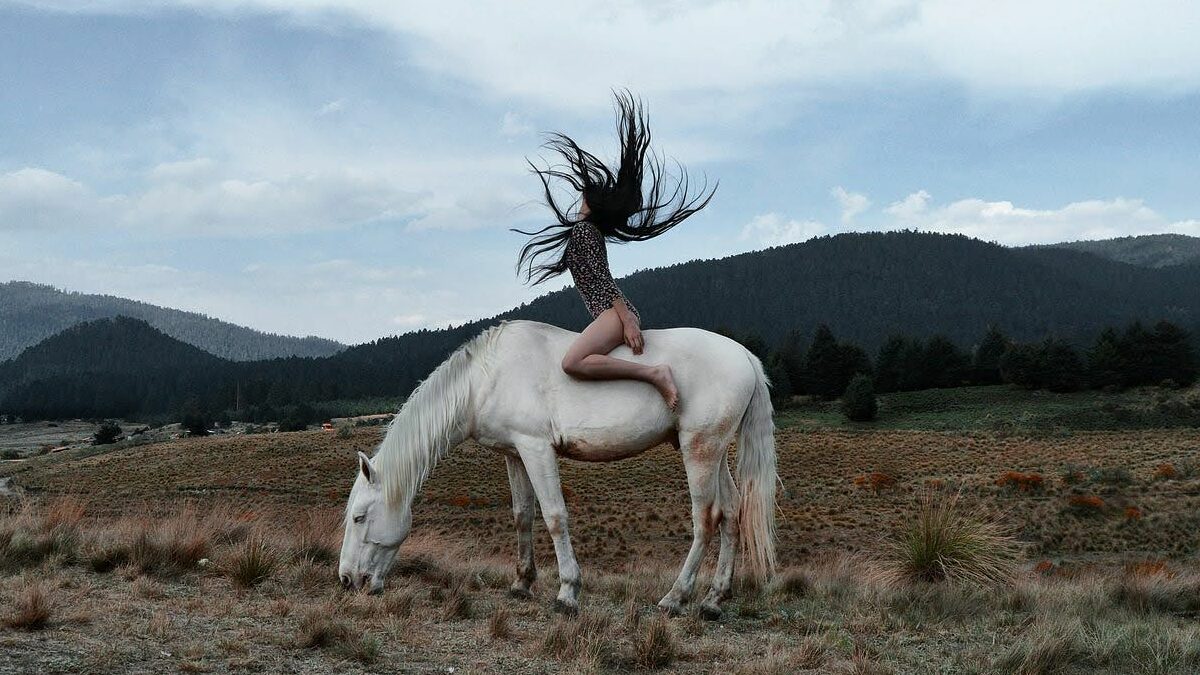
This connection also appears in modern equine therapy. Much of the work does not involve riding. It begins simply with standing near a horse and allowing awareness to settle.
Horses respond to emotional truth rather than performance. Many people report that a horse reflects their internal state with unexpected honesty. When someone is anxious or guarded, the horse may hold tension. When a person softens and becomes more present, the horse often softens too.
This mirroring can help someone recognise their own internal landscape and learn to regulate it more gently.
Many researchers point out that part of a horse’s calming effect may be biological as well as emotional. A horse’s heart is about five times larger than a human heart, which means its electromagnetic field is significantly stronger. Studies from the HeartMath Institute suggest that a horse’s heart field can be detected several metres away. When we stand near a horse, our own heart rhythms and nervous system appear to respond to this field. Some people even show a shift into calmer and more regulated states, where the human heart rhythm synchronises with the horse’s steadier one. For many who spend time with them, it feels less like an idea and more like something quietly experienced in the body.
Equine therapy supports those living with trauma, anxiety and stress. It offers a nonverbal relationship in which trust can rebuild quietly.
For some, the horse becomes the first being they feel genuinely safe with again. For others, the movement and posture of the horse supports physical and neurological rehabilitation.
Many Indigenous practitioners describe these methods not as new but as a continuation of ancestral knowledge about the healing roles horses have long held in their communities.
A Season of Stride
In all these ways the horse continues to do what it has always done. It invites us back into presence. It reminds us of instinct and connection. It meets us with honesty and opens the possibility of healing.
And so we return to the image of the lone horse in the morning field. Muscles gathering. Breath steady. The moment right before movement.
This new year carries that same invitation.
After a season of shedding, a season of stride begins. There is a part of you ready to move, ready to rise with strength and clarity, guided by the instinctive wisdom within you.
The Horse asks you to trust your own rhythm. To move with courage. To stay connected. To follow what feels true.
And to remember that momentum means more than speed. It means moving in a way that feels alive, grounded and aligned with your spirit.
For beautiful experiences with horses follow @_serene.scene_ on instagram. We recommend @holistic_horse_farm and @equineinsightcounselling for horse healing experiences, also my friend @jess.henrich is an amazing equine artist – check out instagram for details.